X Square Robot launch video
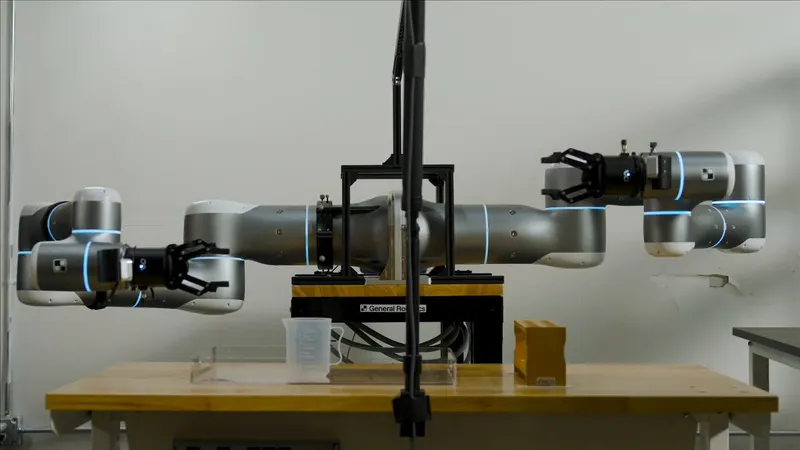
What if a dexterous robot could learn a 20+ step chemistry experiment without a single on-robot training demo? Meet TwinDEX: a pair of co-designed, three-finger, nine-DoF dexterous manipulation interface: one wearable for data collection, one for robot deployment. The twinned
Transcript
Twisting open a bottle cap, operating a pipette and a scooper, coordinating both hands, this pair of robot hands is autonomously performing a chemistry experiment. Not a single piece of its training data came from a physical robot. Behind this lies a long-standing dilemma in dexterous manipulation. Collecting data through unroboted operation is costly and hard to scale. Collecting large volumes of data through low-cost alternatives yields data that is difficult to transfer directly to target hardware. Today, we introduce Twindex, a pair of co-designed three-finger, nine-DOF dexterous manipulation interface. One wearable for data collection, one for robot deployment. Together with an integrated data processing pipeline and policy training workflow, they form a complete collection-to-deployment system. We believe data delivers its full value when embodiment is consistent. This conviction drives us to place isomorphism at the core of the design and to architect data collection. The system is built around three principles, dexterity, consistency and scalability. The end-effector design is the result of a careful engineering trade-off. Additional fingers raise the ceiling of dexterity but impose escalating demands on spatial packing, actuator torque density and deployment reliability. By evaluating a broad set of typical basic human manipulation primitives, we determine that a three-finger, nine-DOF design, seven of which are actively driven, offers the best balance of dexterity, cost and reliability. Consistency quantifies the alignment between collection and deployment devices across kinematics, contact dynamics and visual observation. It directly determines whether the robot-free data can substitute for tele-operated data and policy learning. We anchor on closed-loop deployment performance and work backward to derive quantitative requirements for joint accuracy, temporal synchronization, visual configuration and mechanical properties on the collection side, verifying each in turn. Our results show that Twindex achieves data efficiency comparable to on-robot tele-operation and yields policies with comparable task capabilities in closed-loop deployment. The collection device is a wearable three-finger exoskeleton that decouples data collection from both a robot embodiment and a fixed workspace. One operator, one table and one exoskeleton constitute a complete collection unit. The wearable form factor further provides the operator with intuitive force feedback, enabling high-quality collection of contactless tasks which, without any doubt, are extremely difficult under conventional tele-operation. Now, back to the chemistry experiment. 24 sub-actions, twisting open a bottle cap, operating a scooper and pipette, guiding liquid flow with a steering wheel, by manual coordination across diverse fine objects, each demanding millimeter-level precision and stable force control. All data is collected from scratch through the wearable device alone. Just a few hundred episodes with zero on-robot data. On a standardized benchmark covering representative manipulation primitives, Twindex achieves 5.3 times the data collection efficiency of on-robot tele-operation while maintaining comparable data quality. Twindex was designed for scalable data collection from day one. As collection scales up, the system continues to support tasks of increasing complexity, making data scaling a viable path for general-purpose dexterous manipulation.
Machine-transcribed. Names and numbers may be off.
Similar launch videos



New winners in your inbox, weekly
Get the freshest revenue-making SaaS + the open-source repo to clone each one, before everyone else does.